Anthropic & the Claude Family
Claude Code is one product in a family built by Anthropic, and knowing the whole lineup pays off — each family member solves a different job. This lesson maps the products: what each one is for, how each is paid, and where Claude Code fits.
In this lesson:
- The company and the models behind everything
- The product family: Claude, Cowork, Claude Code, API
- Why Claude Code is the developer's pick
📌One company, one engine
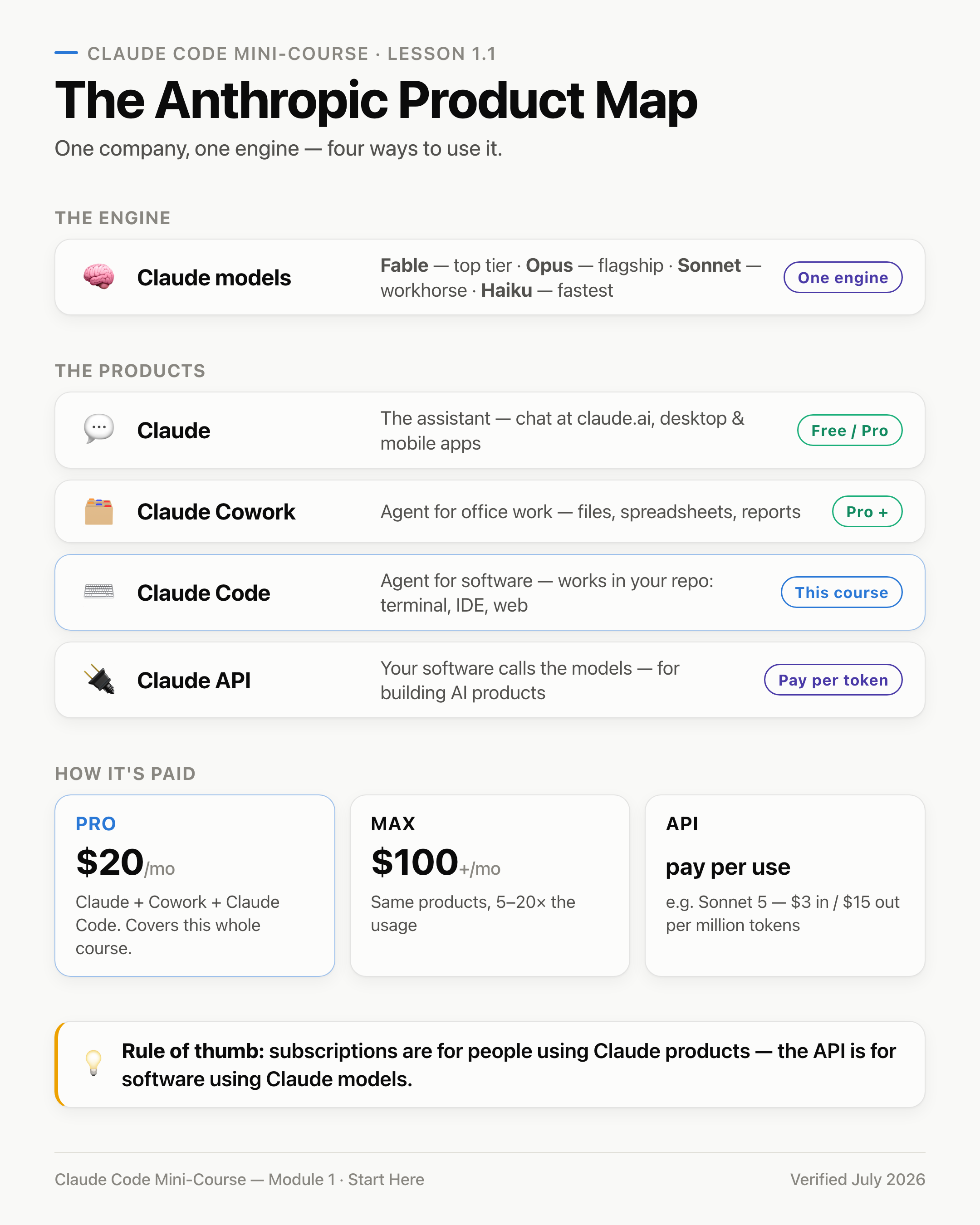
Anthropic is an AI research company known for its Claude models. Every product below runs on this same model family. The current tiers, top to bottom:
- Fable — the newest and most capable tier (the first "Mythos-class" model), built for the hardest reasoning and longest autonomous work
- Opus — the powerful flagship for complex tasks
- Sonnet — the balanced workhorse; most day-to-day coding runs here
- Haiku — fastest and cheapest, for light and high-volume tasks
The products don't differ in intelligence — they differ in what that intelligence is packaged to do: chat, office work, or code. Inside Claude Code you switch models with the /model command; Module 4 covers when each tier is worth it.
📌Claude — the assistant
The product most people mean by "Claude": a conversational assistant at claude.ai in the browser, plus desktop apps (Mac/Windows) and mobile apps (iOS/Android). Writing, analysis, research, working with documents — general knowledge work, in a chat.
Billing is a subscription: a Free tier for light use, Pro at $20/month ($17/month billed annually), and Max from $100/month with 5–20× the usage for heavy daily work.
📌Claude Cowork and Claude Code — the agents
Two products move Claude from answering to doing: you delegate a task, the agent works through it, you review the result.
- Claude Cowork — non-coding work: organize folders of files, build spreadsheets, prepare reports, run recurring tasks. Lives in the Claude desktop app.
- Claude Code — the same delegation model for software: it reads your codebase, edits files, runs commands and tests. Lives in your terminal, IDE and browser.
Both are included from the Pro plan up — no separate purchase. Anthropic also ships specialized editions (Claude Design, Claude Science, Claude Security) — the same idea, packaged for specific fields.
📌Claude API — for building products
The fourth way in is the Claude Platform (API): your software calls the Claude models directly. Different purpose — building your own AI-powered products — and different billing: no subscription, you pay per million tokens processed. For example, Claude Sonnet 5 costs $3 per million input tokens and $15 per million output ($2/$10 introductory pricing through August 2026).
The distinction matters for your own projects: if you use Claude, you subscribe; if you build on Claude, you pay per token.
📌Why this course is about Claude Code
For a developer, Claude Code is the most powerful member of the family. The chat assistant can discuss code you paste into it; Claude Code works in your actual repository — reads it, changes it, runs it, tests it — using the same toolchain you use.
It's also the deepest product to master: custom instructions, skills, hooks, subagents, MCP integrations. That depth is what the two parts of this course cover — first configuring Claude Code to fit your projects, then plugging it into the wider ecosystem of ready-made tools.
One practical note: the $20/month Pro plan covers everything taught in this course.
✅Remember
- Anthropic builds the Claude models — Fable, Opus, Sonnet, Haiku — one engine behind every product
- Claude = chat assistant (browser, desktop, mobile) · Cowork = agent for office work · Claude Code = agent for software
- The API is pay-per-token, for building your own products
- Pro ($20/month) includes Claude, Cowork and Claude Code — one subscription covers this whole course
That's one lesson of 26.
Every lesson, 47 cheat sheets and screenshots, 8 quizzes, an offline copy — yours forever.
14-day refund while you read online.